


Hello there. 👋 Welcome to another installment of Misfortune Cookie. These chapters can be read on their own, but together they trace the slow work of becoming.
“Can you dig it?”
“Will you stop saying that!”
I looked up at Jason from the bottom of a pit we were digging on the deserted beach. He laughed wildly and repeated for the umpteenth time, “Hey, Lani! Can you dig it?”
I never should have told him that I wanted to be an archaeologist. I stabbed the shovel into the sand and started to climb up. This is what happens when you decide to spend the night on Oahu’s north shore with your high school theater friends: you bring alcohol, you strain your lower back while helping to free a couple of sand-stuck cars, and you dig a hole the size of a moon crater, so you can bury a message in a bottle.
“Next!” I yelled for someone else to take over.
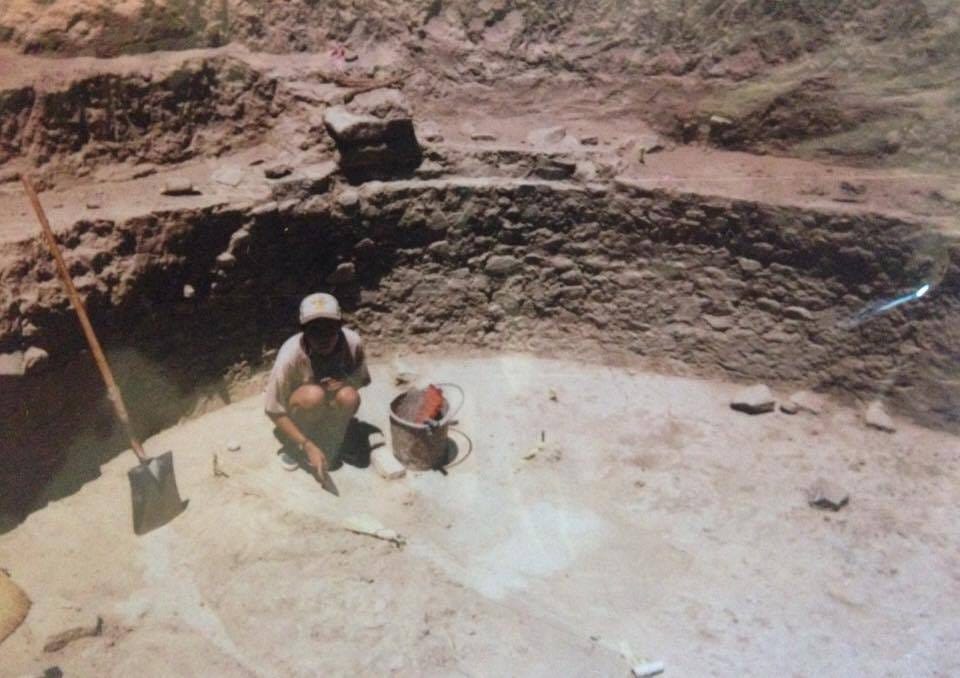
I grew up learning a lot about Native Hawaiian culture but almost nothing about Native Americans beyond school plays dramatizing the first Thanksgiving. It wasn’t until I moved to Colorado to study anthropology that I learned about the different tribes and, specifically, the Native Americans of the American Southwest.
If my junior high years in the Mojave Desert were the launch, then Southwest Colorado was the landing on another planet.
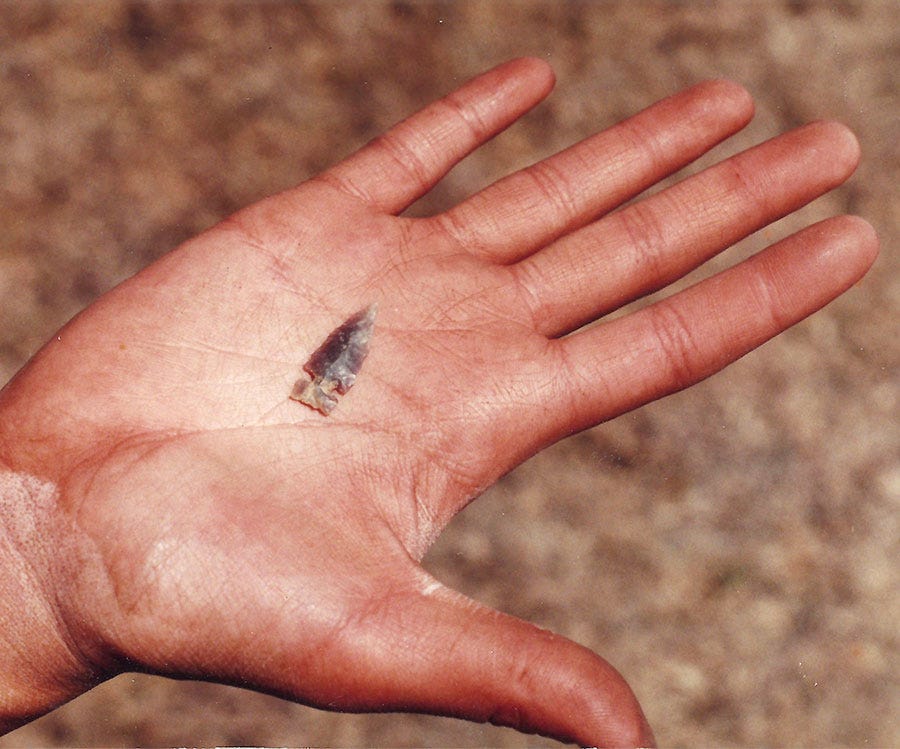
After graduation, I took my first paid archaeology position in a nearby town, close to where the excavation would take place on the Ute Mountain Ute Reservation.
It was one of the most memorable summers of my life, filled with archaeological discoveries like a square kiva when the dwellings were typically round, pottery in the shape of a dog canteen, and an unexpected burial I got to help dig. There were Friday poker nights, casual get-togethers, and even romance.
Our work was known as “contract archaeology” or quick-and-dirty excavation. We’d work ten hours, four days a week, in three crews of roughly ten-person teams. Every morning, each armed with a tool box filled with stuff like tape measures, string, and trowels, we’d pile into dually trucks (that were of the breaking-down temperament) and head toward the res.
The Sleeping Ute Mountain dominated the landscape, but the rest of the reservation was largely flat and uninspiring with brush, sage, and scrub oak dotting the desert grounds. It was hot and dry, and we’d have to provide our own relief from the sun.
Once on the res, we’d stop by the local jail and wait for a round of inmates to join us.
The first time this happened, I asked, “Why are we stopping here?” I looked out the window and saw a man in an orange jumpsuit washing a police car. I wondered what he was thinking.
“We’re picking up a few who are on work release,” Nancy explained. Nancy had been an anthropology classmate of mine, and I was really happy when she was on my crew.
“Work release?” I asked.
“Yeah, work release is when you’re released from jail for the day to work,” Dave chimed in, scratching the hair under his hat.
“Oh.”
“Don’t worry, they’re completely harmless,” Nancy said. “These guys like a day away from the cell. And believe me, they aren’t about to do anything stupid to jeopardize that.”
Silently, I watched, and then heard, the plain-clothes prisoners loading up in the back of the truck.
The rest of my coworkers were women and men, mostly white aged <30, but a few Native Americans who lived there worked with us, too. We were a motley crew. The older men sported full mustaches, and the women tended to be petite. It was a challenging lifestyle, physical, and semi-nomadic.
Once the prisoners were settled into the truck bed, we’d drive off to our various working sites in the middle of the high desert. The parolees usually kept to themselves—at least in the beginning.
My crew had two Native Americans, Cheryl and Becky. Cheryl was little, and her arms were covered with tattoos. She looked like a scrapper, tough, and silent. Becky was larger, her hair always in braids, and she was outgoing with a sweet smile. Cheryl and Becky looked out for me like sisters.
The crew chief, whom everyone called Big Jim, taught me how to use the EDM survey equipment, since I was not able to move as much earth as quickly as contract archaeology demanded. As a result, I did more mapping than the others. The resident geologist, affectionately called Little Jim not because he was little, but because he was slimmer than Big Jim, took me on a tour of the area to help me create my map drawings.
Over time I remembered to turn my baseball cap toward the back so as not to bump my bill into the EDM before looking through it. For others, it was an automatic habit and a funny one to watch until I got the hang of it. Just another reminder of how green I was, kind of like when I showed up on my first day with my squeaky clean tools from the local hardware store.
Sometimes I felt uncomfortable that Big Jim had taken me under his guidance and allowed me to work less physically hard than the others. But I was definitely relieved, too. After my first day shoveling dirt, my lower back was in the kind of pain that I imagined old people experienced. From ground level, I’d watch as piles of dirt fly out of a kiva with uncanny precision. I’m not sure how long it took me to develop some muscles, but it wasn’t until I had, that I attempted to shovel dirt out of a deep pit. Heck, I didn’t realize how hard it was to shovel dirt into a wheelbarrow until I tried it.
I also had no idea that moving a wheelbarrow full of dirt was so difficult! The further the summer days stretched, the higher the mounds of dirt became. There were times I was able to maneuver a full wheelbarrow between the kiva digs or gaping holes to the area where we screened for artifacts, but one day when I couldn’t keep my wheelbarrow from falling over, Cheryl quickly stopped what she was doing, picked it up, and finished the route for me.
“Oh,” I said in surprise, since if anyone was going to help me, I figured it would be one of the men. I looked around, but no one was paying attention.
“Thanks.”
Cheryl smiled.
“I don’t know how you do it, you’re just as small as me.”
Cheryl set the barrow down and flexed her muscles while I laughed.
Nancy and I shared the driving. In the early mornings, we had to keep our eyes out for deer. Skid marks were a common sight. But I never grew tired of dawn breaking over the San Juan Mountains or watching the approaching Sleeping Ute as we got closer to our destination. Southwest Colorado’s changing landscape from peaks to high desert was nature’s playlist—and I listened with my whole body.
Looking back, I wondered what folks thought when Nancy and I would stop off at City Market, fresh after a full day of digging in the dirt. My clothes would be covered in it. My ears became perfect hiding places for more dirt. My skin was flaky and gritty with salt from sweat and the dirt that I tried to brush off in layers.
And while everyone was helpful and became friends, I sensed a different kind of belonging from the Native American crew members. For one, Becky and Cheryl either kept to themselves or hung out with me—and then there was this incident.
One of the men from work-release asked me, “What tribe?”
“What?”
“What tribe are you from?” He pointed at me.
“Uhhh,” I stared at him in disbelief. “None. I’m Chinese and Thai.”
“Really?” he smiled. “I thought maybe Navajo.”
I stood there utterly shocked to my core. Ever since Mom told me how Chinese I looked, I assumed it was obvious to the rest of the world.
Later I told Becky and Cheryl, “He thought I was Navajo! Isn’t that crazy?”
“Nahhh,” Becky said. “You could pass.”
“He was talking about dressing me up in some porcupine quill dress. It was starting to creep me out. I thought he was married.”
“He is, he’s got two kids, too.”
Becky and Cheryl started laughing, “Oh, Lani, relax. You look like ruffled chicken. We thought you were Native American when we first met you, too, or at least half.”
I shook my head. I identified very much with my ethnicity. It was strange to think otherwise. Once again I was dumbfounded.
“Would that be so bad?” Cheryl said.
“I think she’s offended,” Becky smiled.
“I’m not offended,” I protested. Then I realized they were joking, “Oh, stop it.”
Becky and Cheryl were always giving me a hard time, playing around and offering some glib remarks. This was the way my family bonded. Sometimes I was afraid they were picking on me, but Becky would put her arm around my shoulders whenever I started to doubt their intentions. They were helpful, and I fondly recall spending a lot of time laughing together.
Then there was the time when the whole crew except the three of us (plus Marc) went to visit another site. After the truck left in a cloud of dirt, we sat in the bottom of one of the biggest kivas because it was cooler. Becky grinned and asked if I wanted to get high. I panicked, worried about getting caught, but she waved me off.
Any further doubt about their friendship was wiped away when all of the crews were invited to the Ute Mountain Ute Sweet Corn Festival. Normally crews break for lunch and eat while sitting on the ground, or on lunch coolers, or under the tarp for shade from the sun. Afterwards someone might sneak in a nap. Then everyone smoked cigarettes, except Big Jim, who had quit after 30 years. I felt bad that Jim was stuck with the all-smoker crew.
The festival was a welcome break from that routine. All of the crews eagerly waited in the long line that formed from the metal barn building. I was starving at the back of the line, as we somehow ended up being the last crew to show up.
Then Becky and Cheryl excitedly pulled me away and brought me over to where the women were making flatbread. They introduced me to their family and friends, who also were attending the festival. I felt honored. I watched the flatbread dough bubble in the large pans of oil.
Summer passed quickly, and soon the archaeologists who once started their days wearing t-shirts and baseball caps were donning knitted hats and thick jackets. We’d spend extra time warming up the cars while holding thermoses of coffee between our hands. Still, as the sun rose, everyone would shed layers because the physical labor warmed up our bodies.
Hi Lani, l wanted to be an archaeologist when l was in high school because l loved history … anyway, l love how you narrate your adventures; your conversational tone and shifts draw me in and the connections you make with people show your caring and playful nature. And the physical landscape sounds fascinating, its diversity. Really enjoying your memoir 🙏😊
I've always felt drawn to a bit of archaeological digging myself and often watch Digging for Britain. The specialists that I've seen always seem to be using a paint brush to "dig" so I think they must come in after workers like yourself have finished the serious grafting for them!
These Misfortune Cookie excerpts always take me somewhere unexpected and I admire how all of your chapters are equally happy to stand alone. You describe your fellow diggers perfectly as well as your reaction to them. I have experienced this kind of friend as well: seemingly hard-boiled but with a marshmallow interior, but only fleetingly displayed!
So many interesting things you've done, Lani!