

Teaching English While Asian
on appearances and expectations

I wish it didn’t say ‘Article voiceover’, instead it should say, Lani voiceover 😏
When I was first considering moving to Thailand and enrolling in a TEFL (Teaching English as a Foreign Language) program, not once did I consider my ethnicity. In fact, my class was a diverse group. We were American, of mixed backgrounds, as well as Belgian, British-Thai, Cambodian, Indian, and Mexican.
Our instructors were Australian, Romanian, and South African. The class was a knock-out positive experience, and I was additionally thrilled to learn that we were under the tutelage of one of the most respected teachers in the industry.

So, by the time I received my certificate, my fears about returning to the profession—due to my ordeal at a budding Waldorf school and from my elementary education graduate program—were put aside. Although, none of that made a difference because no one would hire me.
Unlike Sharmila Ganapathy’s discovery that she didn’t “look the part” through stumbling upon Dave’s ESL Cafe, a long-standing site for job seekers, I can’t remember how I came to the realization.
If you’re American, like me, you might be wondering, how did prospective employers know what I looked like? Well, in Thailand, and much of the world, apparently, you are strongly expected to include a professional headshot, your age, and marital status on your resume.
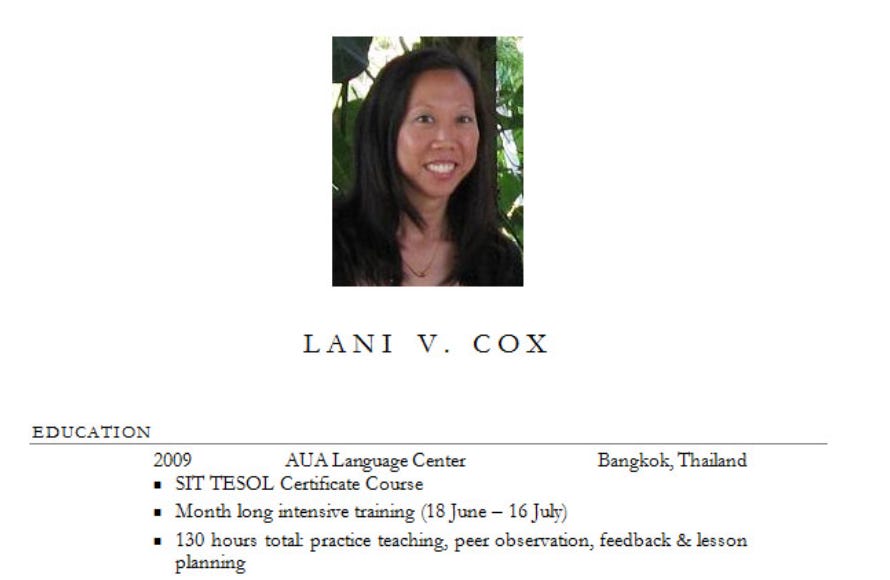
I come from the land of STRONG anti-discrimination laws, but I was very much in a world where appearances matter. At an international school, I was handed a very ugly orange polo and loathed every Wednesday that I had to wear it.
You’re also forced into retirement at age 60 in Thailand. My manager who had spent decades building up the school was utterly crushed when he was forced out. He hadn’t lost any sharpness, he simply no longer looked the ideal part. My husband had to convince a kindergarten in China that he wasn’t too old at 45 to work with young learners. His demo class had a high sign up rate because he was so creative and dynamic.
In the age of TikTok, and social media, it might seem odd to be considered too Asian-looking to teach English, but back in 2009, the perception of me was stereotypical. My friend told me that after I left a red truck taxi, the passengers remarked on how good my English was. Another time, my Taiwanese friend suggested that the reason I was met with hostility for speaking English around town was because other Thais were jealous and believed I was showing off.
After a time, I decided teaching English in my mom’s home country wasn’t going to happen, so I applied for a position in Ecuador and was immediately accepted. On the street I was mistaken for Chinese Ecuadorian and called chinita ~ whereas in the classroom, none of it mattered.
After a few months, I returned to Thailand to give it another go—both with my personal relationship and with work. While the former fell through, the latter took off. You could argue it was because a friend recommended me to her employer. Although, I’ve seen a pattern over the years, and the real reason, I’d argue, was that a Westerner hired me.
And this has been the case with every teaching position I’ve held since.
One friend tried to explain the other side this way. If he wanted to learn kung fu, he’d naturally picture someone who looked like Bruce Lee. If he wanted to learn French cooking, he’d imagine a French chef. English, he argued, was no different.
It didn’t sit well with me, though at the time I couldn’t explain why.
As it turned out, I wasn’t the only exception to the rule. My closest compadres at that first school were two other Asian Americans, hired soon after me, a Filipino American and a Nepalese American. At my current language center, there are, again, two other Asian Americans, both of Cambodian descent.
My high school friend, a Japanese American, ran through as many years as she could on Japan’s JET program, too. There’s something to be said about teaching where your family originally comes from. This was certainly my intent in the beginning.
But I must include a story from my husband’s teaching days from Ankang, China. Even though they hired a Chinese American at the university (not him), his colleague was once denied entry into the school because he was judged too tanned and Chinese to be an English teacher. So he scaled the walls in order to get back to his apartment on campus.
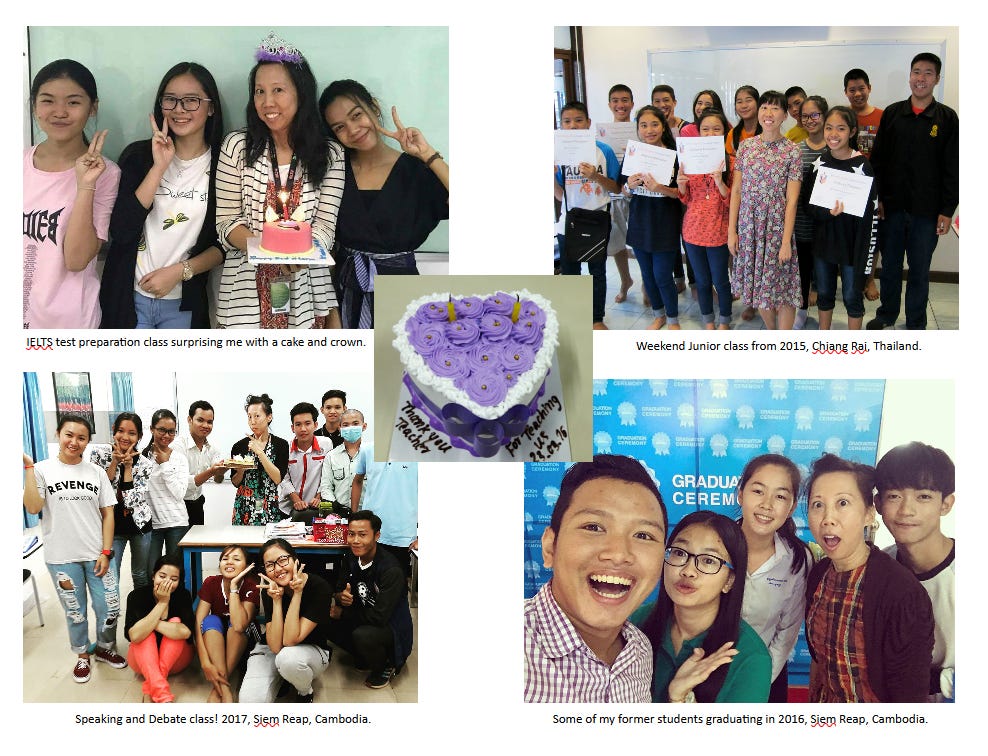
What I’ve come to realize over the years is that people aren’t simply hiring someone to teach English. They’re hiring the image they associate with English. The irony, of course, is that language and ethnicity stopped being the same thing a long time ago. Yet what I actually bring into the classroom can’t be captured in a headshot. When I enter the classroom with my unpolished grammar, I do so with a lifetime growing up under the American flag.
Even now, after all these years, almost every day, I get stared at when I’m around town. Is she Chinese? Japanese? Korean? And still, I do not anticipate it, and unless I’m in a particularly good mood, I don’t like it. I’ve learned to open my umbrella or raise my hand to block my face.
I don’t mind when students say nǐ hǎo to me or carry all these assumptions of who I am because I’ll be given the opportunity to break down those preconceived notions. I relish it. But I do mind not being given the chance to prove I’m capable of teaching English.
Schools and parents clearly have expectations—and so do I.
Thank you for sharing this, Lani. While working for the British Council I saw so many talented teachers who struggled at times because they "didn't look the part". The organisation came to champion the diversity of its teachers, but it could be a hard sell in some cultures. Another aspect of this was the championing of non-native speakers who were fully qualified and gifted teachers. They were some of the very best teachers, who tended to know the language better analytically than native speakers and knew more about the pitfalls of learning the language. But not all students accepted them as equal to native speakers.
The line that stuck with me most is that schools weren't hiring someone to teach English, they were hiring the image they associate with English.
It's a strange kind of exclusion: not being seen as foreign enough to be exotic, or American enough to be "native," just caught in the gap between the two. The detail about your husband's colleague scaling the wall because he looked "too tanned and Chinese" says more about the absurdity of these assumptions than any argument could. Thank you for tracing this across so many countries and years without losing the humor in it.