

19. May break my bones...
A story about the names we’re given, the ones we reject, and the ones we reclaim.

Previously on this memoir: Sticks & Stones. Now we’re stepping into May break my bones…the part where words do what playground pebbles never could ❣️No homework required, but the last chapter adds some color. Thanks.
Before the move to California, when we got rid of so much stuff, I’d sit on the stairs and look through my dad’s books on the landing. I was too young to understand The Kama Sutra, and his engineering texts weren’t of interest, but I took his horoscope and dream dictionary and his yellow construction hard-hat to my room.
We have a newspaper clipping of Dad holding an artifact from one of his engineering projects. Maybe that’s why I took the hard-hat, or maybe a hat just felt more personal. I already had his dog tags.
I spent hours flipping through his high school and college yearbooks. Later I’d wonder what it was like for a Chinese man to attend school as a minority in the 1960s in Syracuse and Oklahoma City.
As I got older, I read what his classmates wrote, but when I was younger I looked only at photos and funny hairstyles. I searched every page for another Asian student, in one yearbook there was one other male.
Whenever I look at photos of my father, I’m proud of how handsome he was. Grandma and Mom were proud of his height, too. At five-ten—tall for those days—I was satisfied he was better-looking than the other Asian student.
I wondered if Dad was more popular than him. Based on the photo, Dad looks more charismatic, straight white teeth, beautiful smile. Grandma said he studied English constantly. He recorded himself on cassette tapes and was a member of Toastmasters.
When I found his Toastmasters certificate on “Longest Speech Listening,” I asked Tim (Mom’s boyfriend) what it meant. Larry (my younger brother) remembers one of his recorded speeches titled “Chinese gypsy finds his home.” A couple of years ago, I discovered the tape among my belongings in boxes.
As I studied the man I hardly knew, his dog-eared joke book seemed less like casual reading and more like another one of his studies, maybe to understand American humor, or the culture, or maybe just to fit in.
The thing about being Asian in America is that many people don’t think you experience racism. Racism happens to Black people, other immigrants, maybe Mexicans, but Asians? Nah. It’s like people think of us as pork: America’s other white meat.
Part of the reason Asian Americans aren’t known for being picked on is that traditionally we don’t talk about it. This has changed with social media, but when I was growing up, hardship was something to endure. We swept things under the Oriental rug. Racism was another trial, you shivered, stomped your feet, and kept going.
Then there’s my mother.
When I was in kindergarten, I came home crying because a kid called me “chop suey.” She didn’t hug me, wipe my tears, or call the school. She laughed. Knowing her, she probably thought it was a good one. I’m just glad “chop suey” didn’t stick, as she was the first person to call me four-eyes after I got glasses.
Ironically, the kid who said it was probably Asian like me.
In Hawaii we stand apart—physically in the middle of the Pacific, and culturally with our own pidgin language, born from plantation days when everyone worked together under the sun. Outsiders might see Hawaii as openly racist, but we know black and white is too simplistic. There are many hapas, and “What are you?” is normal curiosity, not an insult.
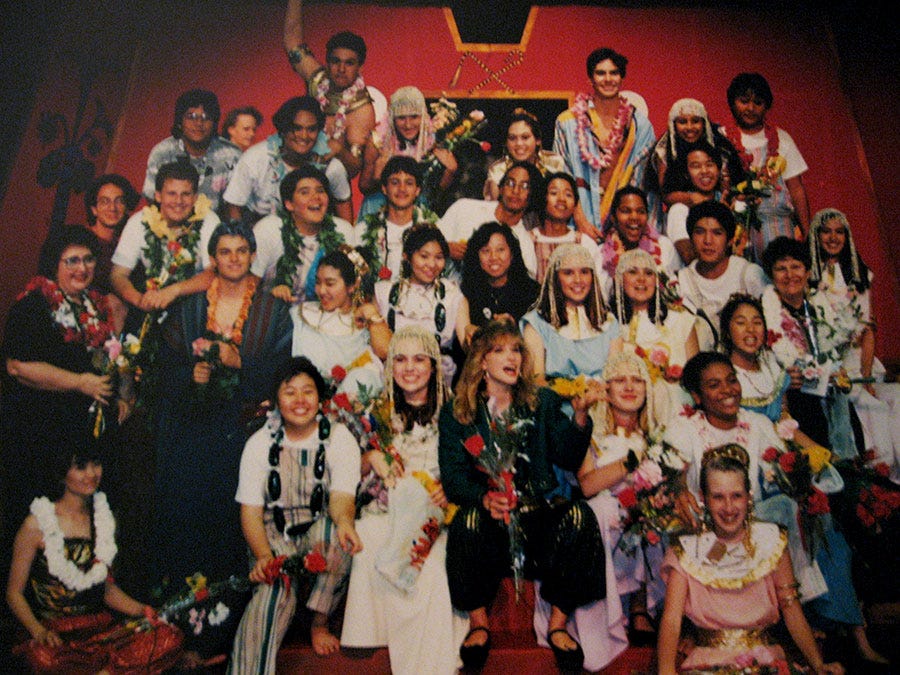
So when I moved to Colorado for college, I wasn’t bothered by the question, only by the responses.
“I’m a mutt,” or “I’m German and Irish,” followed by, “Well, it’s different with Asians. You know what I mean.”
I didn’t. But I let it drop. Many Mainlanders had a less nuanced idea of being multiracial. People assumed I was Chinese or Japanese, sometimes Hawaiian, and I had to explain that I wasn’t native Hawaiian.
In graduate school, another student argued it was easier to let Mainlanders think we were Hawaiian. I said it was disingenuous. Being native Hawaiian is rare, many were wiped out by Western diseases. Being born in Hawaii doesn’t make you Hawaiian, and being born in America doesn’t make you Native American.
By happenstance, this made me an Asian American ambassador, explaining that not all of us speak with accents. But I failed plenty of times too ~ frozen when someone yelled something at me.
At Fort Lewis College in tiny Durango, Colorado, the minorities were Native Americans and Japanese exchange students. There was one other Asian American, but she wasn’t friendly. Maybe she liked being the different one because she was attractive. Living in Durango made me very aware of standing out.
It’s a peculiar feeling, like waking up in the middle of a dream still happening around you, so over time I tried not to think about being the only Asian in the room.
But when Larry visited from New York City, I was jolted back. We were sitting in a restaurant booth when he suddenly snapped, “Why do they keep staring at us?”
I muttered, embarrassed, “You get used to it.”
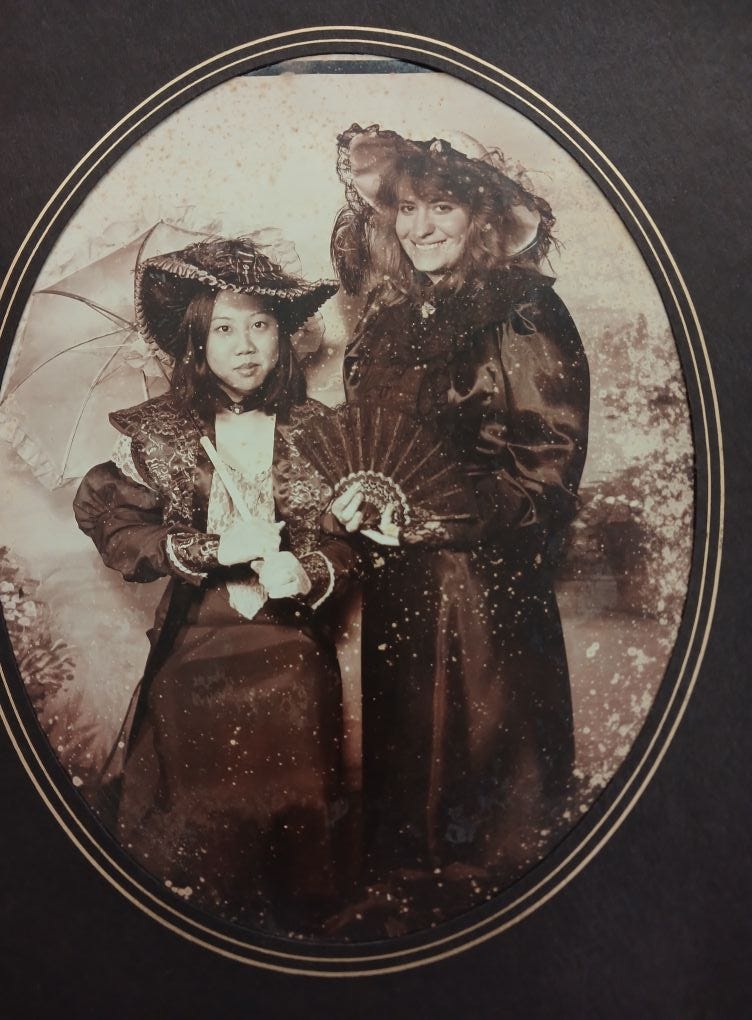
After a college theater performance, when everyone went to the front of the stage to greet friends and the audience, a guy came up to me and said, “Konichiwa.”
I stared at him, unsure how to respond. I wish I’d yelled, “Howdy, partner!” and tipped an imaginary cowboy hat.
“Konichiwa,” he said again, grinning.
Deadpan, I replied, “I’m not Japanese.”
That’s when I saw his friends watching. They burst out laughing. I’d been part of a dare. Confused and irritated, I slipped backstage.
Walking back to my apartment with my roommate, Nadya, I heard people yelling. It took me a moment to realize the words were directed at me.
“Boy, am I really hungryyy! I sure could go for some fried rice!”
“Smells like beef and broccoli out here!”
“Do you smell that?”
“Yeah, sweet and sour pork!”
It was dusk. We’d just passed students hanging out, probably drinking. As I realized those menu items were for me, my body did an adrenaline dump. I fought the urge to turn around and yell every obscenity I knew or something in their language:
“Actually, I think it smells like beefaroni and SpaghettiOs!”
“Is that a hint of Hamburger Helper?”
“Swanson’s Salisbury steak TV dinner!”
But I kept walking, head down, fists in pockets. If only I’d been quicker, I could’ve gone the American breakfast route.
“Corn flakes!”
“Unfrosted Pop-Tart!”
“Scrambled eggs, bacon, and dry-ass toast!”
When we got home, I asked Nadya, “Did you hear what they were saying? Were they talking about me?”
“I don’t know what you’re talking about.”
“Nadya,” I said firmly. “You didn’t hear those kids calling me all those Chinese dishes?”
“Oh, Lani. Just ignore them. They’re assholes.”
She sat on the couch; I sat in the chair across from her.
“My heart’s still racing,” I said. “Are you kidding me? What kind of insults were those? Couldn’t they come up with anything more creative?”
“I should go back and kick their asses.” I was still fired up, though both of us were under 5’4 and out of shape.
“Forget about it,” she said.
So we sat there in the dark because neither of us turned on the light.
Despite the garden-variety beef-and-broccoli incidents over the years, one experience confused me the most. That’s not to say the drive-by “fake Chinese” yelled at me in Eugene, Oregon didn’t jolt me. Or that the Latino teen in a mall in Greeley, Colorado, who stood inches from my face chanting, “ching-chong-ching” for an eternity didn’t leave me stunned and hurt. Of course they did.
But this particular event unfolded over time.
Like every earnest teenager, I chose my first-day-of-high-school outfit with precision. I’d inhaled Sweet Valley High books and imagined my moment. I wore a cute acid-wash denim skirt with a matching tank top, although who would notice at a school as big as Barstow High? [Remember? The armpit of America.] The place was overwhelming. Even after scouting my classes beforehand, I still felt lost, weaving through the dense crowds, trying to make it to my next room.
Then I tripped and skinned my knee.
“Are you okay?” Someone asked.
“Yeah, thanks,” I muttered, too ashamed to look up.
I walked into science class with blood trickling down my leg. Peak pubescent shame. Class had already started, I had no tissue in my Liz Claiborne purse, and no time to run to the bathroom. So I sat in the front row pretending my knee wasn’t on fire.
“Uhh… did you know your leg is bleeding?” A student whispered.
“Yes. Thanks.” I stared straight ahead, summoning the inner discipline of an ROTC cadet.
Then I felt it—the shove. My entire desk chair being pushed out of the row by the girl behind me. She used her foot like a lever. She and her friend stifled giggles. I scooted myself back into place, but it didn’t matter. She kept doing it.
After a few days of this nonsense, I told the teacher. Nothing changed. She pushed my chair every day. I sat front and center, so everyone watched.
Sometimes I braced myself against the desk like a cartoon deer trying not to slide across ice. Other times I let her push me all the way until I was practically kissing the chalkboard, then scooted myself back, ignoring their delighted snickering.
I never spoke to them, so I had no idea why they disliked me. I vaguely remembered being asked on the first day, “Are you Japanese?” Maybe I said no. Maybe I gave them my standard line: “Chinese, Thai, with a little bit of Russian.”
Growing up in Hawaii, diversity and ethnicity were points of pride. It never occurred to me that elsewhere this wasn’t the case. I wasn’t used to being bullied. In Hawaii, people exploded, argued, maybe fists flew, and then you moved on. Not this slow, senseless drip of humiliation.
Eventually, I tried to stand up for myself. I turned around and said, “Stop it.” No question mark. No meekness. Just STOP IT.
The she-beast ignored me, smirking.
The harassment only stopped after they saw me with Tim. He took me to a football game, and I noticed the two girls watching us. The next day one of them asked, “Was that your boyfriend?”
“No. That was my mom’s boyfriend,” I was horrified they thought he was mine. Although, he was eleven years younger than her.
“Oh. We were just curious.”
After that, the pushing magically stopped. As if her foot had suddenly developed a cramp. Maybe they thought he was cool. Maybe they knew him from his Army buddies’ legendary parties. Maybe they saw his nickname, “Ace,” scrawled in the girls’ bathroom. Maybe he talked to them. I never found out.
The mystery stayed unsolved until I collected more outsider moments, stateside and abroad. But instead of letting them calcify into resentment, I read widely, wrote constantly, and developed a contemplative mind.
Eventually I arrived at an answer that feels obvious now, the kind of thing that’s like asking fish what they’re swimming in:
I am not what other people perceive me to be.
I wasn’t what those girls thought. Whether their opinion shifted because of Tim or something else, I didn’t change. They did.
But I couldn’t rely on accidental rescue again. I’d have to navigate a world that often saw me in ways that didn’t match my inner life. And while I know I’m not alone in that, it’s strange how each of us still has to figure it out for ourselves.
Thank you for reading and listening. Your support means the world. If this chapter stirred something, I’d love to hear from you. As I like to say, comments create conversations.
Wow Lani — I smiled, I got aggravated — I remembered the systemic and overt racism of the culturally and linguistically diverse community of kids I worked with in Melbourne ... so pissed off with the lack of action of the teachers in the classes where the girls pushed you along — so fabulous you didn't change, whatever prompted change in them — good. Tim, your Mom, their own conscience — all of the above.
Love Hawaii, to grow up in that resilient, diverse and inclusive community — fists, and all. Thank goodness for that blessing of acceptance.
"I am not what other people perceive me to be."
Hoooray — and thank you for reading, gives such depth; I find myself cheering you along. Your final resolve ... a message for us all.
"But I couldn’t rely on accidental rescue again. I’d have to navigate a world that often saw me in ways that didn’t match my inner life. And while I know I’m not alone in that, it’s strange how each of us still has to figure it out for ourselves."
🙏😊💖🌀
Lani, thank you so much for sharing these memories with such honesty and courage. The way you’ve woven together your father’s story, your own experiences of racism, and those moments of both pride and hurt makes clear to me how much you’ve carried … and how deeply you’ve reflected on it all.
In listening, I could feel the sting of those taunts and the isolation of being stared at, yet also and much more importantly … the quiet strength in your voice as you keep walking, keep naming, keep remembering. What moves me most is how you ab-soul-utely refused to let those bullying experiences harden into bitterness … instead, you’ve decided to turn them into contemplation, writing, and a deeper knowing of yourself.
And your realisation that you’re not what others perceive you to be, my dear friend, feels like such a hard won Truth … one that shines beyond the cruelty of those encounters. Thank you for sharing your journey; it’s a powerful act of reclamation and resilience, reminding me that while the world may be all too quick to misname any of us … our inner life remains firmly our own.
Thanks so much for being here, Lani. We need you. 🙏💖